

Gadgets
March 19, 2026
The Sweet Pea Vine
THE SWEET PEA VINE
3 Everyday Fun Gadgets that Help Kids Learn
This month’s Sweet Pea theme is Gadgets, Tools, and Doohickeys.
True to our Sweet
Pea heart, we are focusing on fun devices that are:
1. Educational
2. Kid Friendly
3. Kid Powered
1. Measuring Tape
Give a child a measuring tape and suddenly everything needs to be measured! Measuring helps teach and reinforce number recognition. Measuring tapes give little ones experience in relating numerical value to distance. Experimenting with measuring tapes provides preschoolers with hands on experience comparing the length of different objects and distances. Measuring helps them associate longer distances with higher
numbers and shorter distances with lower numbers. There is also motor value to playing with measuring tapes as children learn to manipulate the release button, pull out the tape, and measure the distance. Measuring measures up as a fun gadget for kids!
2. Scissors
Learning to cut with scissors is a fundamental preschool milestone. Parents andeducators should provide safe, developmentally appropriate scissors designed forpreschool use AND should take special care to provide lefties with left handed scissors.Cutting things out with scissors fosters bilateral dominant/non-dominant handcoordination as one hand is dominant in completing the task while other assists. Dominant/non-dominant coordination is needed for many daily tasks such as writing, stringing beads, tying shoes, gluing, completing fasteners, and coloring.
3. Tin Can Telephone
Making a tin can phone should be a requisite to kindergarten! A tin can telephone is a fun gadget that is a little bit science, a little bit crafty, and a little bit mysterious. Technically, a tin can telephone is an acoustic (non-electrical) speech-transmitting device made up of two tin cans attached to either end of a taut string or wire. Kids can talk into their can and their speech vibrations are passed along the string to the other
can. A tin can telephone is a great device for preschool espionage and fun adventures. Tin can telephones teach kids about sound vibrations, speech communications and timeless fun! Talk to the can!!
The Sweet Pea Vine
The Sweet Pea Vine
The Sweet Pea Vine
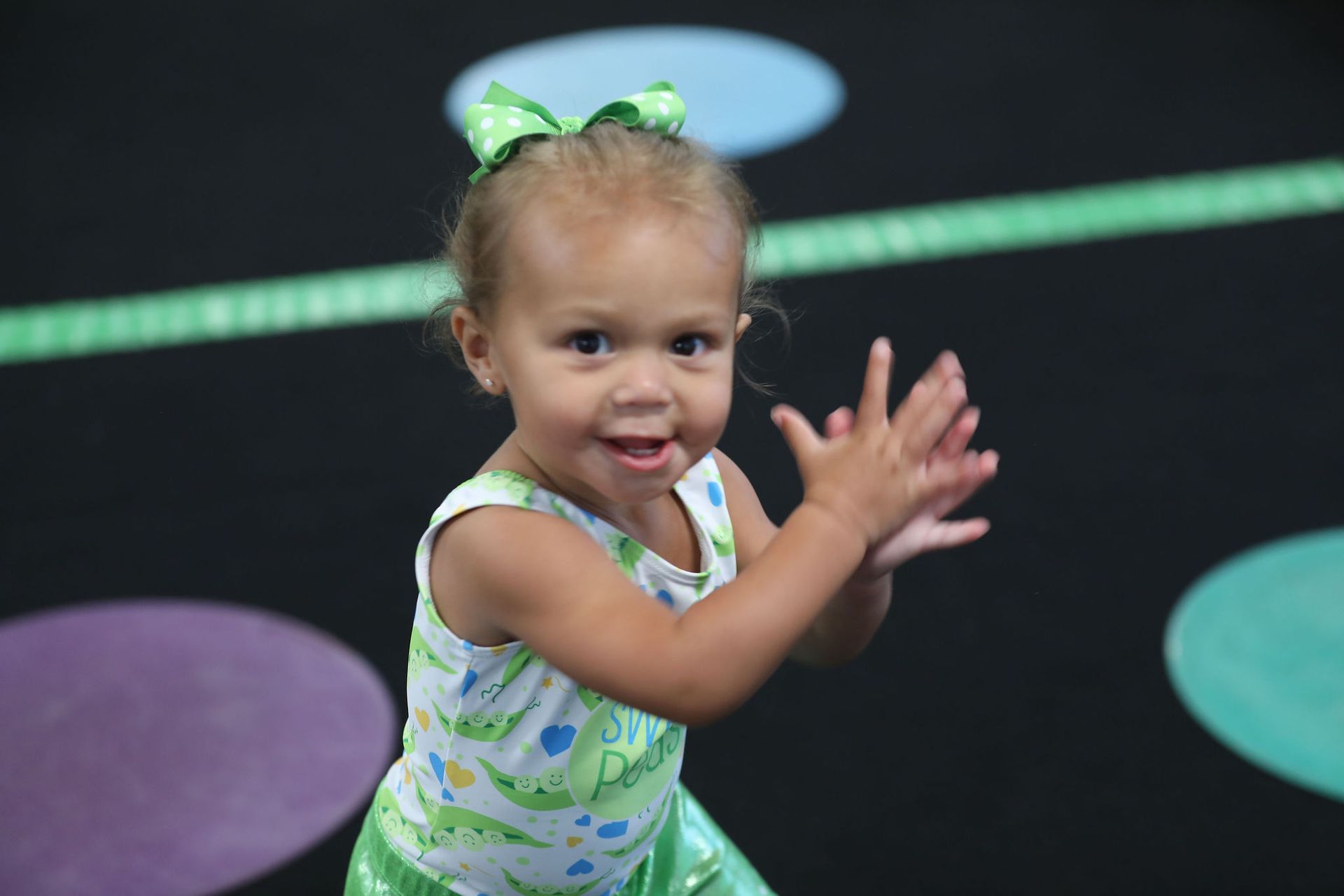
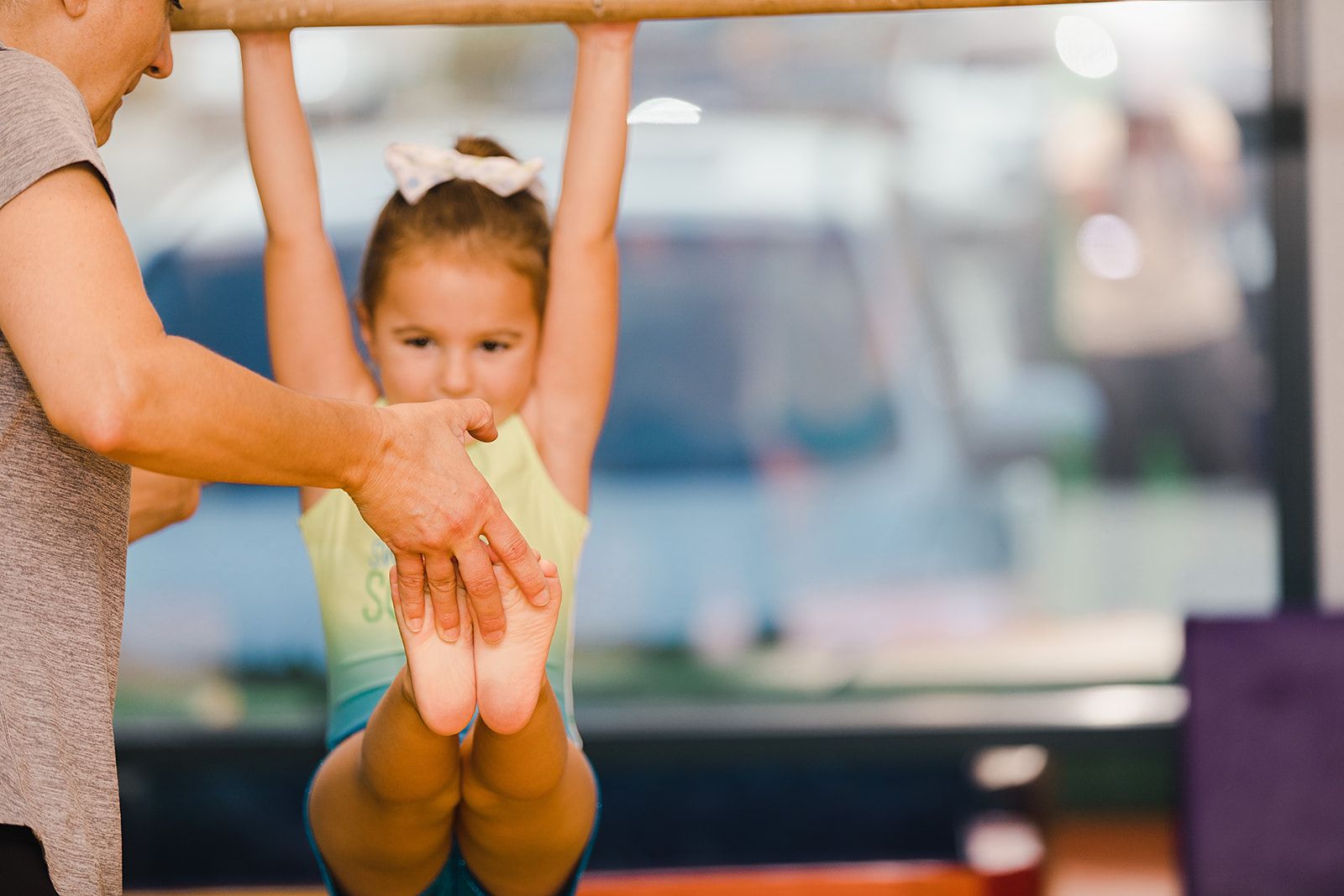
THE SWEET PEA VINE Children are Visual Learners Children, like adults, learn in different ways. Some children are auditory learners and learn best through hearing what they are learning. Others are kinesthetic learners and prefer learning that gives them opportunities to touch and manipulate. Experts believe, however, that most children are visual learners . Our Developmental Focus Sweet Peas Gymnastics highlights educational and developmental concepts through the active learning gymnastics classroom. Our “I Spy” theme this month focuses on VISUAL perception. Visual perception is the ability to interpret and understand what is seen. Visual perception helps the brain process what is seen and then form thoughts, make decisions and create action. In our gymnastics class, we are incorporating visual processing through thematic inclusions such as discerning shapes and colors, finding select Sweet Peas characters amongst a varied background; identifying (and mimicking) different gymnastics positions of a character; and using visual memory to identify body parts used in a skill. Our older Sweet Peas will look at a sequence of gymnastics characters and discern how they are shaped differently (tuck, straddle, pike) and then remember and execute that sequence. We will also incorporate skills that focus on visual motor skills such as viewing objects up close and viewing objects from a distance. Our Gymnastics Focus Muscular strength development is one of our gymnastics goals this month. We will work on skills such as hangs on the bar, lifting knees up to pull objects down from the bar and inversion skills on floor where our Sweet Peas learn to support their body weight through their arms and upper body. We are also working on varied forward beam passes and being able to balance on the beam while inverting to look through a cone. This is an introduction to more advanced inversion skills on beam in the years to come! On floor we are practicing forward rolls, donkey kicks and cartwheels and we are busy in vault working on foot placement, hops, rebounds, balance and approach sequences. We hope you love what you see this month in Sweet Peas!
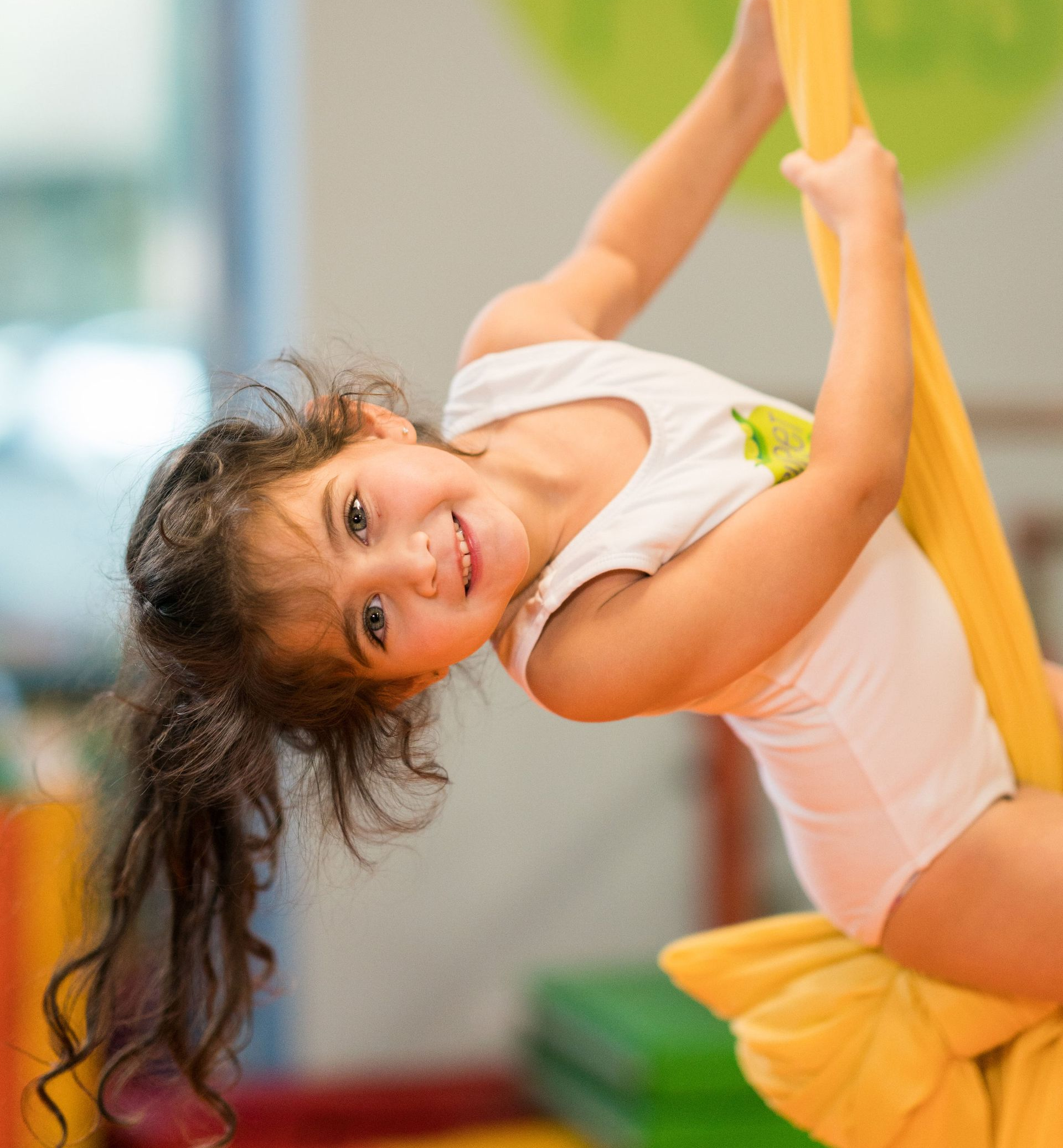
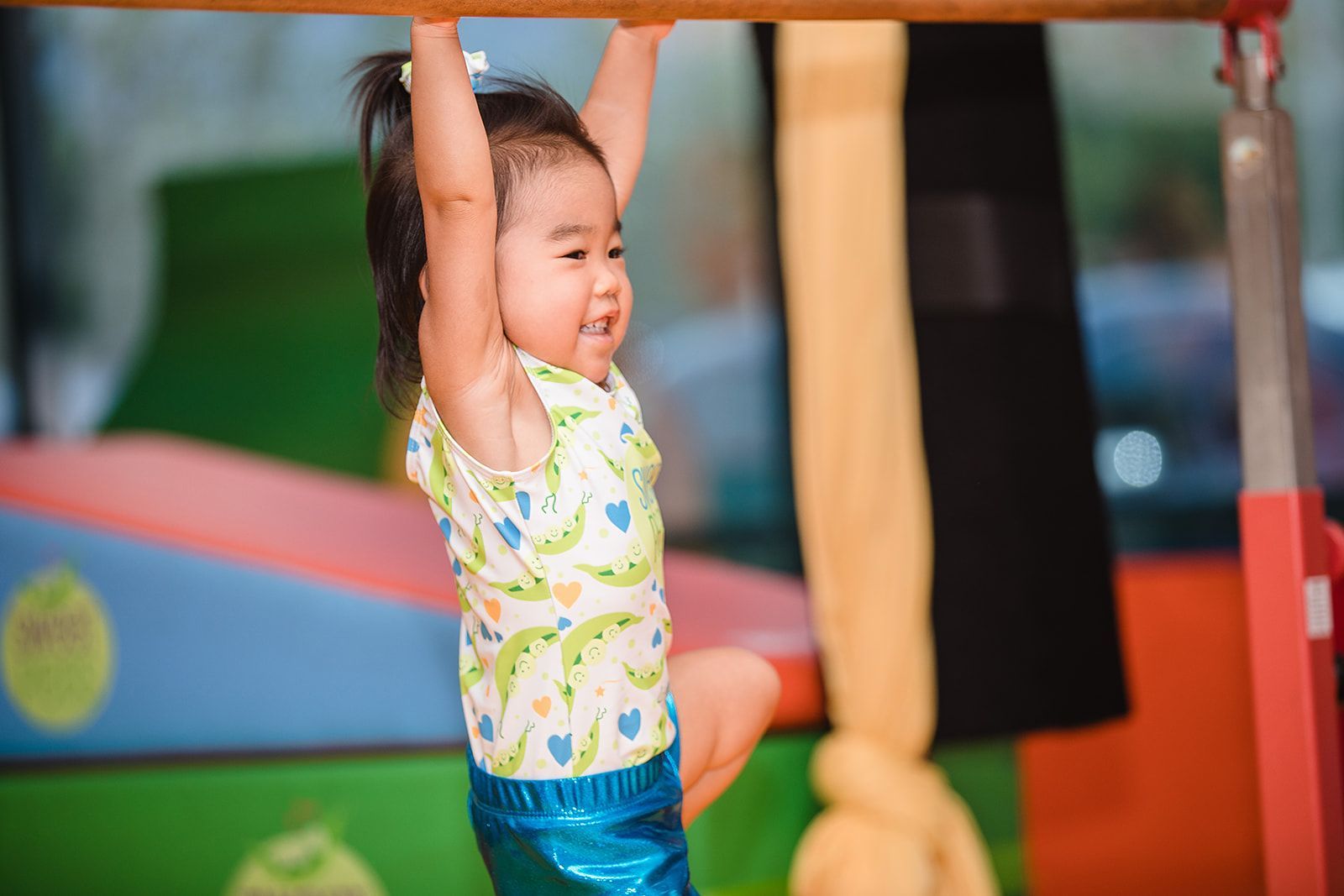
THE SWEET PEA VINE Gymnastics Gives Kids a Leg Up in Life Who did 12 ups at school? A gymnast. Who just tucked and rolled on the soccer field? A gymnast. Who's the 1 year old climbing over the back fence? A Sweet Pea gymnast! How can you spot a gymnast? 1. The 1 year old climbing over the back fence is a gymnast. Gymnastics promotes motor planning. Motor planning is the brain's ability to assess, organize and carry out the motions needed to complete a task. When a Sweet Pea grips the bar, swings forward and taps their feet on a barrel, that young brain is processing multiple complex movements including grip, head positioning, stepping forward, supporting full body weight by the arms, gauging the swing, lifting the legs, tapping the barrel and landing back on the mat. Getting a leg up over the back fence is a piece of cake for a Sweet Pea. 2. The 2 year old shimmying up the pole is a gymnast. Gymnastics builds whole body strength. Gymnasts use all their muscles! Gymnasts hold on tight, balance, swing, roll, dive, run, jump and twist their way to amazing muscular development and strength. Even the 12 or so muscles in your child's smile will get a work out in gymnastics class! 3. The 3 year old swinging the highest is a gymnast. Gymnastics provides amazing sensory processing opportunities. Inversions, rolls, spins and jumps are developmental powerhouses. Gymnastics engages our Sweet Peas' vestibular system and helps them develop their proprioceptive sense. The vestibular system provides information to our brain about where our body is in space. It helps our brain determine if our body is stationary or moving, how fast it is moving, and in what direction. The vestibular system is crucial for balance, coordination, motor control of the eye and bilateral integration. A well developed vestibular sense helps little ones develop confidence and trust in their movement. This is why Sweet Peas rule the swings. 4. The 4 year old high chanting and clapping for everyone is a gymnast. Gymnasts learn side by side. They try new skills, fall down, get up and try again. Gymnasts learn about sportsmanship, courage and determination. They understand what it feels like to succeed and they know what it feels like to miss. Gymnastics helps children develop pride in their accomplishments and in their friends' accomplishments. The little one at the bottom of the slide clapping for each child as they slide down? She is a gymnast. 5. The 5 year old who has fallen on her skates three times, and got back up four ... A gymnast. Gymnastics teaches kids that they can do hard things. Gymnasts know that it's okay to fall or slip. They learn to keep trying. Gymnasts learn how to listen to teachers and coaches. They learn how to apply corrections and strive for improvement. Gymnasts are teachable. Gymnasts are ready to learn.
The Sweet Pea Vine
THE SWEET PEA VINE Did you know that rolling... 1. Engages the VESTIBULAR SENSE and provides our brain with information about motion, head position, and spatial orientation. Our vestibular system helps stabilize our head and body, and helps us maintain balance and posture. 2. Builds CORE STRENGTH . Forward rolls activate the abdominal muscles and stabilize the spine. 3. Promotes VISUAL TRACKING and development. Changes in head positioning challenge the ocular motor system to adjust and calibrate. Visual tracking helps us track words on a page, write in a straight line, participate in sports, navigate a hallway and more! In the ROLL When kids are not busy rolling themselves around, they can learn a lot from observing and interacting with things that roll. • Toys that can be rolled, pushed or pulled help children develop fine motor skills . • Passing a rolling toy from one hand to the other promotes crossing the midline , which is important for bilateral coordination . • Riding on and pushing large rolling toys promotes global motricity as children employ complex motor planning and engage multiple muscle groups. • Playing with rolling objects promotes coordination between vision and action and gives children experience evaluating distances. • Playing with or on rolling toys helps children learn to anticipate the act of slowing down or accelerating and experience maintaining balance while moving. • Rolling play encourages a child's creativity as little ones use their imagination to create stories, characters and scenes for their rolling play. • Rolling objects also help children understand the relationship between pressure or force and movement and basic concepts of movement and collision. • Playing with rolling toys provides social opportunities as children learn to roll alongside friends or roll a toy or ball back and forth to a playmate. Get out the balls! Get out the cars! Hop on the ride toys! It's time to get rolling!
